
The four planes
The architecture separates four concerns. Each fails differently and changes at a different rate, and keeping them separate is what lets any one of them change without disturbing the others. Every plane section ends by naming what can be swapped inside it. Part Three then turns to where the four planes meet people: the operator, the market and the web.
Section 7 · Part two
The shape of the architecture
Read the four planes from the top down. The Cognition Plane reasons: it decides what to do and in what order. The Tool Plane is everything the system can do, exposed as one universal MCP surface. The Execution Plane is the infrastructure those capabilities run on. The Data Plane holds the state your business owns and the sources it reads.
Read the four planes from the top down. The Cognition Plane decides what to do. The Tool Plane is everything the system can do, exposed as one MCP surface. The Execution Plane is the infrastructure it runs on, and the Data Plane holds the state your business owns. They fail differently and change at different rates.
The separation pays off when something goes wrong. A reasoning failure is a bad decision made with good tools. A tool failure is a correct decision that cannot be carried out. An infrastructure failure removes capability whatever the reasoning. A data failure is confident action on a wrong picture of the customer. Diagnosis starts with asking which plane is at fault, and that question has an answer only if the planes were separated deliberately.
The planes also change at different rates, and that is the basis of composability. The Data Plane’s shape is the most stable thing in the system. The Tool Plane turns over fastest as the ecosystem matures. Coupling them, for instance by letting one vendor’s database become your master customer record, turns a routine tool swap into a migration project.
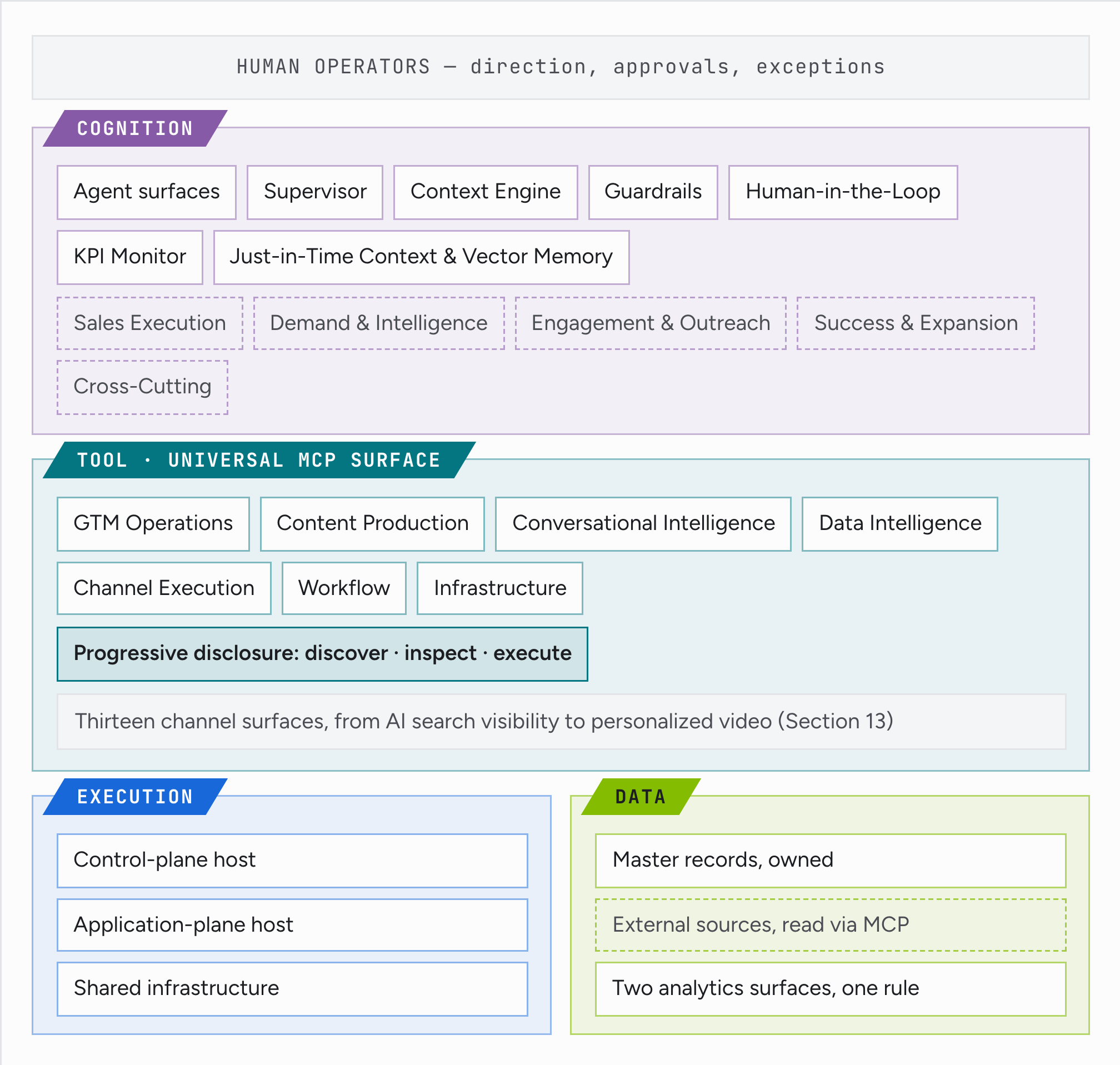
Separate the four planes because they fail differently and change at different rates. The stable planes protect your business record; the fast-moving ones absorb the churn.
Cite as: revWorx (2026). A Composable Reference Architecture for Autonomous GTM Operations, First Edition, §7. revworx.ai/architecture/7