
Section 11 · Part two
The Data Plane
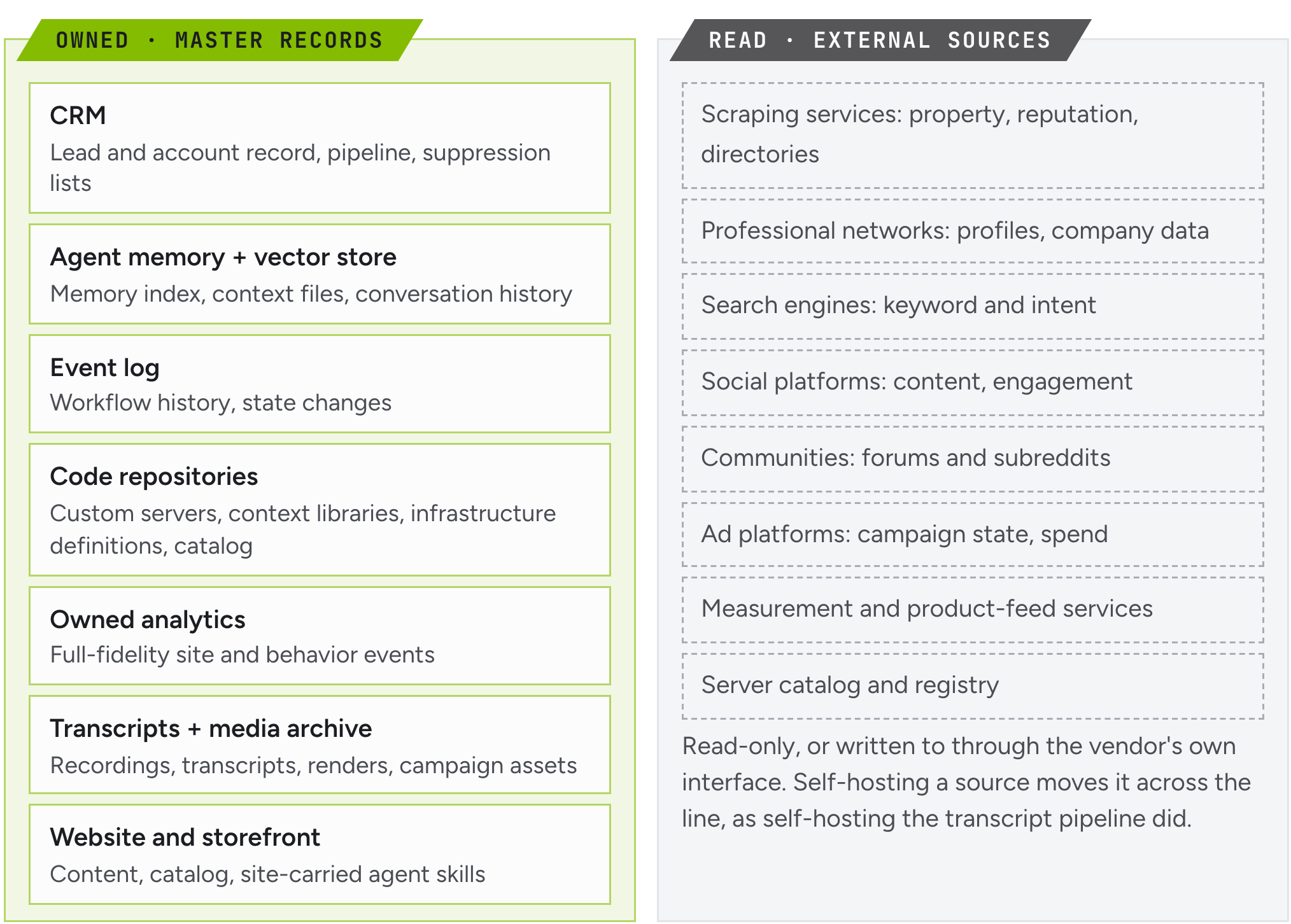
The Data Plane draws one line and defends it: state your business owns, separated from data it reads. Everything on the owned side has an explicit backup, retention and migration policy, because losing it means losing the business’s memory. Everything on the read side is a dependency with its own rate limits, access terms and chance of disappearing.
The Data Plane separates the state your business owns from the data it reads. Owned state has explicit backup, retention and migration policy, because losing it means losing the business’s memory. Read data is a dependency. Keep the master record outside every tool and define each analytics event exactly once.
This is the plane that makes every other plane composable. Because the master record lives here and in no tool, any tool can be replaced without a data migration. The system also caches what matters rather than re-querying outside sources on every interaction, which is cheaper, faster and more resilient, but only once each thing has been assigned to one side of the line.
11.1Two analytics surfaces, one rule
Analytics is where architectures quietly acquire two versions of the truth. This one runs two surfaces on purpose, with non-overlapping roles, and one rule that keeps them honest: define each event once, on a single surface, and never re-create it on the other.
The platform analytics surface is the authority for outcomes, such as a lead generated, an appointment booked, a quote requested or a purchase made, because those must flow to the ad platforms as conversions and join to spend. The owned analytics surface is the authority for engagement: page views, guide reads with scroll depth, funnel paths. Being self-hosted, unsampled and unaffected by ad blockers is what makes it a credible owned substitute for third-party intent data.
The problem being designed out is definitional drift: two systems counting leads slightly differently, and a monthly meeting spent reconciling them instead of acting on them. Neither surface is the source of truth for your business. The CRM holds the master record, and the Cognition Plane joins all three on the identity of the contact.
Keep the master record outside every tool and defend the line between owned and read. Define each analytics event exactly once. The most stable plane is what lets the others change.
Cite as: revWorx (2026). A Composable Reference Architecture for Autonomous GTM Operations, First Edition, §11. revworx.ai/architecture/11