If you
work anywhere near a RevOps, GTM or growth team, you can probably
identify this:
Your stack keeps expanding and is now larger and more complex (and potentially fragile) than ever.
Your data is more abundant and richer than
ever but also more siloed than ever.
Your self-generated pressure to “do something impactful
with AI” gets heavier every day.
And yet, day to day, it still feels like you’re spending way too much time stitching
together half-broken workflows, chasing down missing CRM fields and
nudging humans to follow processes they never really intended to follow from the start.
The next RevOps tech stack won’t just be “CRM + automation +
AI features.” It will be a matrix of semi-autonomous AI agents that integrate, orchestrate and
optimize how revenue gets generated, all built and run as a real
engineering discipline.
This discipline is what we’re calling Agentic RevOps
Engineering.
The intent of this inaugural post is to:
Introduce a conceptual model for organizing how to think about
this emerging discipline, and
Open the doors on revWorx AI, a
platform for tech-savvy operators to practice Agentic RevOps
Engineering by actually building & deploying an Agentic
CMS (from scratch) and setting up & operating an
Agentic CRM through guided learning journeys.
Over
the last decade, Revenue Operations (RevOps) has
grown from “ops by another name” into the connective tissue of
modern go-to-market:
It unifies sales, marketing, support, customer success and
often finance around shared goals, processes and technology.
It owns the revenue tech stack: CRM, marketing automation,
support/success tools, data warehouse, reporting, analytics and the
integration fabric.
The result? Most organizations now run with some form of a RevOps
OS. But, that OS has some serious pain points:
Tool sprawl: thousands of products, many
with overlapping features.
Brittle workflows: lead routing, handoffs,
approvals and SLAs that break with system changes.
Manual glue: spreadsheets, one-off scripts,
“shadow admins” and heroic ops people with a flair for tech to
keep the train on the tracks.
Dashboard-heavy, action-light: endless views
and reports but limited ability to close the loop from insight →
execution.
Meanwhile, AI has already moved from novelty to necessity.
But many deployments are still:
Helpful, but fundamentally assistive. A human
still has to ask, interpret, guide and act.
The next step is agentic AI where systems don’t
just answer questions, but pursue goals, make decisions and
take multi-step actions to achieve defined goals as an
agentic revenue tech stack.
But how do you wire in reliability, resiliency, transparency, cost
control and ultimately – trust?
That’s where a new discipline needs to show up.
Let’s
start with definitions.
RevOps is the end-to-end operating model
that unifies revenue teams, processes and technology (people |
processes | platforms) to drive revenue performance.
DevOps is the culture and practice of
building and operating software systems as one continuous lifecycle;
from code to production, with heavy emphasis on automation, CI/CD,
and observability.
AgentOps is emerging as the operational
backbone for networks of autonomous AI agents, including the
practices, methodologies, tools and systems used to create, deploy,
monitor, and govern AI agents in production settings.
Agentic AI is all the rage as we close out 2025
and is defined as AI that acts with autonomy, initiative and
adaptability to pursue and achieve goals: it plans, acts,
learns and adapts rather than simply responding to prompts.
Put these together and a clear picture emerges (see Conceptual Model below):
Agentic RevOps Engineering is the
practice of designing, building and operating production-grade
agentic systems at the heart of the revenue engine; combining RevOps’
ownership of the GTM lifecycle, DevOps’ software discipline and
AgentOps’ lifecycle management of autonomous agents in production.
This is what has to exist if you want:
Agents that maintain CRM hygiene and pipeline health, not
just suggest next steps
Agents that orchestrate lead-to-opportunity-to-renewal
workflows, not just draft emails
Agents you can trust, because they are
deployed with guardrails, evaluation and observability just like
any other critical system
At the junction of three
converging disciplines, i.e. RevOps, AgentOps and DevOps we can visualize the core promise of Agentic RevOps Engineering:
Align &
optimize revenue
Build & operate systems
Manage & govern agents
But, the pathway to delivering
on this promise is paved through synthesizing highly specialized skill sets that
emerge at three overlap zones shown in the Conceptual Model below and that we
annotate as:
Agentic RevOps
Orchestration
RevOps Platform Engineering
Agentic Reliability Engineering
Let’s
now have a closer look at each of these overlap zones.
Agentic RevOps Engineering:
A Conceptual Model
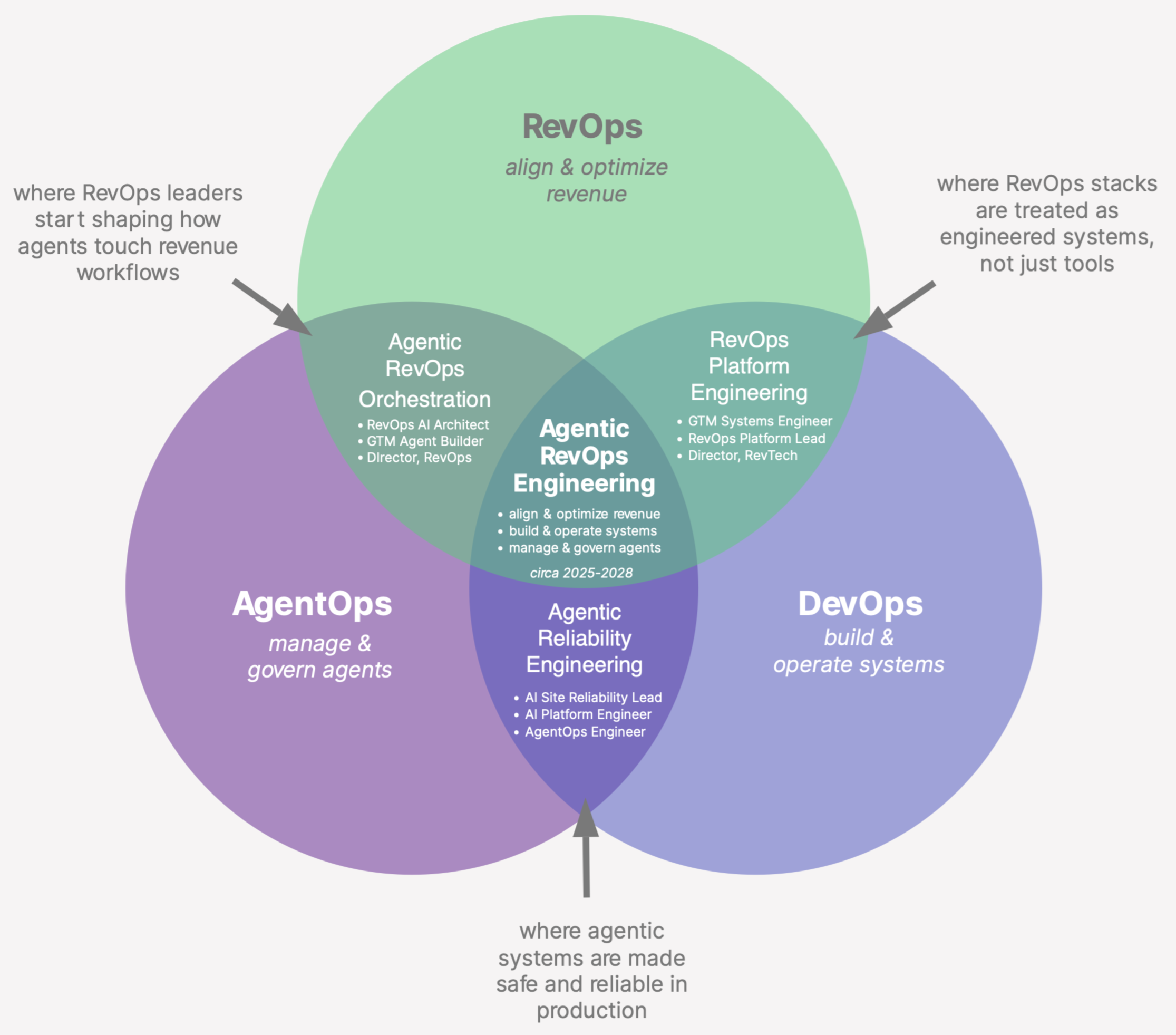
An emerging discipline at the intersection of RevOps, AgentOps and DevOps (2026-2028)
The central zone of the model defines Agentic RevOps Engineering as a synthesis of (3) overlapping zones of skills and expertise where job titles already reflect the direction in which we're heading.
Agentic RevOps Orchestration is where RevOps leaders begin shaping how agents participate in revenue workflows, before worrying about the underlying infrastructure.
Think of it as:
Designing the goals, policies, plays and feedback loops that guide AI agents as they work alongside humans across the customer journey.
Examples:
-
Inbound lead orchestration: Agents qualify, enrich and route inbound leads; trigger segment-specific cadences; and escalate edge cases to humans using RevOps-defined rules and AgentOps-defined guardrails.
-
Lifecycle playbooks: Agents watch customer journeys (from prospect to promoter), triggering actions when thresholds are hit: risk alerts, upsell motions, expansion conversations.
-
Experimentation at the workflow level: Agents test variations of outreach, routing, or qualification and automatically advance winners within RevOps-set constraints.
Roles gravitating here include RevOps Leaders, RevTech Directors, GTM AI Program Leads, and GTM Agent Builders, i.e. people who already live at the intersection of strategy, policy and process.
RevOps Platform Engineering is where RevOps stops being “the team that owns the tools” and starts owning the revenue platform as an engineered system.
In other words:
Applying DevOps principles, automation, CI/CD, observability, infrastructure-as-code to the entire RevOps stack so that GTM processes are stable, testable, effective and continuously improved.
This looks like:
-
Treating CRM configuration, routing logic, scoring models and integrations as version-controlled platform artifacts, not ad-hoc configs that eventually become technical debt.
-
Having pipelines for safely rolling out process changes with tests for data contracts, SLAs and expected conversion behavior.
-
Instrumenting observability across GTM workflows; when ETL jobs fail you know which segments stop receiving emails or which reps lose visibility.
Here you’ll see titles like GTM Systems Engineer, RevOps Platform Lead, Director of RevTech, i.e. people who already think in systems but are now adopting DevOps conventions.
Key takeaway: RevOps Platform Engineering is the runway for Agentic RevOps Engineering. If you can’t reliably change your stack today, you’re not ready to embed autonomous agents into it tomorrow.
Agentic Reliability Engineering sits where AgentOps and DevOps meet. It’s the craft of making sure your agents behave safely, reliably, transparently and cost-effectively in production.
Definition in practice:
Treating agents as first-class production services with policies, logs, evaluations, SLOs, and incident playbooks not as opaque black boxes.
This includes:
-
Governance & safety: Policy-as-code defining where agents can act (e.g., read-only vs write access to CRM) with audit trails for every decision and every action.
-
Behavioral evaluation: Measuring agents not just on uptime but also on outcome quality, policy adherence, cost optimization and impact on business metrics.
-
Incident response: Runbooks for what happens when an agent misbehaves: rollbacks, throttling, quarantining agents and feedback loops that enable learning from failures.
Typical roles here: AI Platform Engineer, AgentOps Engineer, AI SRE / Site Reliability Lead.
When you combine Agentic RevOps Orchestration, RevOps Platform Engineering and Agentic Reliability Engineering, you arrive at the center: Agentic RevOps Engineering as a coherent, end-to-end discipline and professional practice.
It would be fair and reasonable to ask: Isn't this just buzzword layering?
Short answer: no, and the timing matters to explain why.
First, a few converging trends:
RevOps has gone mainstream. Analysts now
describe it as the model that unifies customer engagement across
functions and integrates people, processes and technology
end-to-end.
DevOps is the default for serious software.
If your product involves software systems, you’re already using
DevOps or something very close to it.
AgentOps is crystalizing as a practice.
Multiple vendors, consultancies and practitioner communities are
converging on AgentOps as the way to monitor, govern and
lifecycle-manage agents in production. Agentic AI is moving from hype to deployment. Major cloud and enterprise vendors now describe agentic systems as autonomous, goal-driven, multi-step systems that plan, act and learn, not just chat.
In other words, the foundational elements already exist. RevOps,
DevOps and AgentOps are all in the 'here and now' as synthesizing siloes with Agentic AI serving as a catalyst for convergence.
Agentic RevOps Engineering is what happens when
you recognize that your revenue performance is ultimately a function of how well you bring these three areas together.
The timeframe shown on the model (i.e. “2026–2028”) is deliberate. Over these next few years,
we’ll see a steady, undeniable shift from:
The organizations that make this shift early get:
Faster, more consistent execution of GTM plays
Higher quality data and insight from autonomous maintenance
Safer, more governable AI deployments around revenue, where
risk is highest
And a clear talent advantage: people who can
architect, not just operate, the new stack
Concepts
are nice; so let’s make this a bit more concrete.
In an agentic RevOps stack, your core platforms
don’t go away, instead they grow up and they get smarter...a whole
LOT smarter:
Your CRM becomes an Agentic CRM
Your content and messaging ecosystem becomes an Agentic
CMS
Your workflows are executed by orchestrated agents,
not just static rules
An Agentic CRM is a CRM where:
Agents continuously maintain data hygiene, enrichment and
routing
Pipeline health is monitored by agents that offer
suggestions, manage campaigns and execute updates in alignment with
policy priorities
Forecasting isn’t just a report; it’s a set of agents
reconciling signals across tools and touch points and flagging risks
early
In other words, the CRM stops being a passive, glorified
database and becomes an active, dynamic,
continually learning and evolving system of agents
that co-own data quality, process adherence and insight generation.
An Agentic CMS is a content system that can:
Assemble outreach artifacts, landing pages and enablement
assets dynamically based on account, segment and context
Use performance signals to iteratively refine what gets sent,
to whom and when
Coordinate content life cycles across multiple agents, i.e.
prospecting, nurturing, expansion so that the customer experience
feels seamless and coherent
The key pattern: content and context are modeled in a way agents
can understand and manipulate safely, rather than being siloed in
static docs and campaigns.
These two pillars, Agentic CRM and Agentic
CMS are where Agentic RevOps Engineering becomes tangible.
If you can design and deploy them, you are no longer just “using
AI”, you are engineering an agentic revenue system.
If
you’re reading this, you might already be the kind of person this
discipline appeals to.
Typical starting points:
RevOps / Revenue Technologists / RevTech Directors
GTM Systems & Platform Engineers
GTM operators (SDR, AE, marketing ops, CS ops,
product/growth)
AI-curious builders inside GTM teams
The roles annotated on the model diagram above give a sense of
where job titles are already drifting: RevOps AI Architect, GTM Agent
Builder, RevOps Platform Lead, AI Platform Engineer, AgentOps
Engineer, AI SRE and so on.
If you see yourself on that list or want to grow into it, then
Agentic RevOps Engineering is your swim lane.
All of
this brings us to why this post exists at all.
revWorx AI is being built as a skills
development platform for tech-savvy
operators who want to:
Understand Agentic RevOps Engineering as a discipline
Practice Agentic RevOps Orchestration, RevOps Platform
Engineering and Agentic Reliability Engineering in realistic production-grade scenarios
Build Agentic CMS and Agentic CRM
systems, not just read about them
The core learning style is Learning Journeys:
You don’t just watch videos or copy templates.
You engineer functional components of an
agentic RevOps stack with scaffolding, examples and space to
experiment, discover, learn and share.
You do it in a collaborative, supportive environment, alongside fellow travelers who are also exploring this exciting uncharted territory.
revWorx
AI is not positioning itself as the sole authority on Agentic RevOps
Engineering. Rather, we aim to be a platform for
shared discovery, experimentation and learning;
a place where practitioners shape what “Agentic
RevOps Excellence” looks like when engineering principles & practices are applied to define the 'next' RevOps tech stack.
If
this resonates, here’s a simple way to think about your next steps:
Use the Agentic RevOps Engineering Conceptual Model.
Use the model to organize, structure or guide your thought process:
Agentic RevOps Orchestration: How should agents
participate in our GTM workflows?
RevOps Platform Engineering: Are we treating our
RevOps stack like engineered infrastructure?
Agentic Reliability Engineering: If we ship agents,
how will we keep them safe, reliable and predictable?
Inventory your stack through the
lens the model presents.
Where
are you already strong? Where are you still “click-ops”? Where
are you experimenting with AI without clear governance?
Start small, but think in systems.
Pick
one workflow, say inbound lead handling or renewal risk detection
and ask: “What would this look like if an agent owned the
mechanics and humans owned the judgment?”
Join a community that’s taking this
seriously.
This is precisely what revWorx AI aims
to become.
If you want to be among the first wave of Agentic RevOps
Engineers, i.e. the people who know what the next RevOps stack looks like because they designed it, built it and deployed it...then:
👉 Get on the revWorx AI waitlist.
You’ll get:
The next RevOps stack will be Agentic.
The only open
question remaining is - who gets to build it?