
Section 13 · Part three
Channel surfaces
A channel surface is a route to a person: the place where your market first sees you, hears from you or talks back. Search results, a social feed, an inbox, a phone, a chat window, a partner’s portal. The architecture provides thirteen of them, in three groups by the job they do in a buyer’s journey: surfaces where you are found, surfaces through which you reach out, and surfaces where you serve someone who has already arrived.
A channel surface is a route to a person: search, a social feed, an inbox, a phone, a chat window or a partner’s portal. The architecture provides thirteen, grouped by their job in a buyer’s journey: where you are found, how you reach out and where you serve. Sequence across them from one place and check one suppression list everywhere.
The architecture treats channel surfaces as a concept of their own, separate from the tools that happen to provide them. The distinction matters because tools change and channels do not; email will outlive every email platform. Conflating them leads to a common mistake: reading “we replaced a tool” as “we lost a channel”, or buying a tool to acquire a channel the stack already had.
13.1Thirteen surfaces in three groups
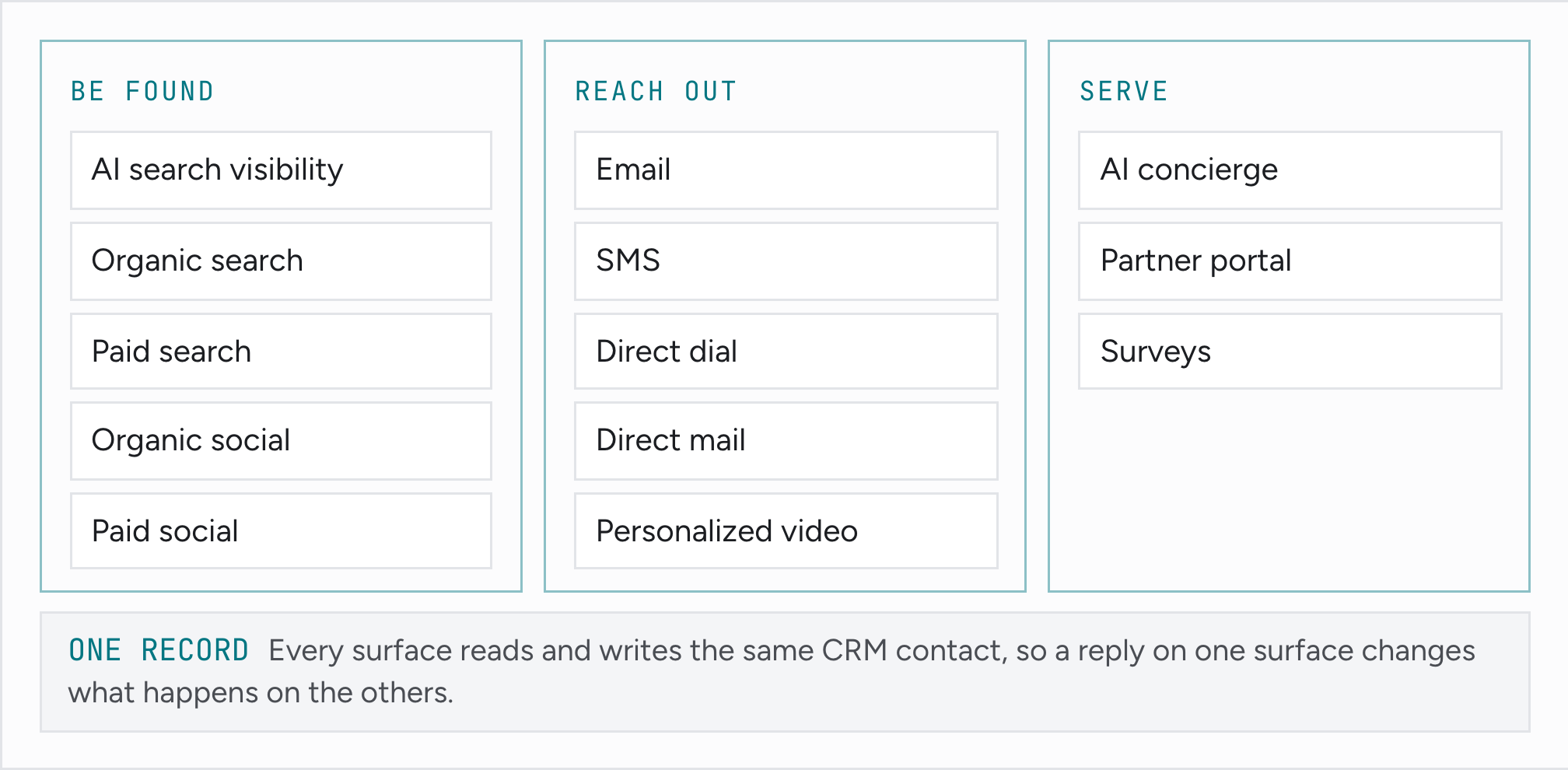
Table 2 on the following page maps each surface to the cluster that provides it, the capability that drives it and the gate that governs it. The third column is the one most often missing from a channel plan.
| Surface | Provided by | Driven by | Gate |
|---|---|---|---|
| AI search visibility | Content Production | Content and copy | Design and brand checks |
| Organic search | Content Production, Data Intelligence | Content and copy | Publish approval |
| Paid search | Channel Execution | Paid media management | Spend confirmation in tool |
| Organic social | GTM Operations | Content and copy | Brand guardrail |
| Paid social | Channel Execution | Paid media management | Spend confirmation in tool |
| GTM Operations (CRM) | Outreach orchestration, dynamic nurture | Suppression check; copy approval | |
| SMS | GTM Operations (CRM) | Outreach orchestration | Consent and suppression check |
| Direct dial | GTM Operations (CRM) | Meeting booking | Human places the call |
| Direct mail | Channel Execution | Outreach orchestration | Spend confirmation; copy approval |
| Personalized video | Content Production | Content and copy | Copy approval |
| AI concierge | Conversational Intelligence | WEB Agent (venue concierge, knowledge base) | Guardrails; escalation to human |
| Partner portal | GTM Operations (CRM) | Partner-portal crawling, attribution | Payout approval |
| Surveys | GTM Operations (CRM) | Customer health monitoring | Frequency limit |
Notice how many surfaces the CRM provides. Email, SMS, direct dial, partner portal and surveys all come from the system that also holds the record. That is deliberate. Reaching out from the system of record means every send, reply and bounce lands on the contact it belongs to without a sync step, and the suppression list is checked against the same record the message is addressed to.
The groups are not funnel stages; a customer served by the concierge may be reached by email a month later and found through search a year after that. The grouping exists so one question can be asked of any surface: found, reach out, or serve? That answer sets who approves the action and how it is measured and paced.
13.2Three rules for operating across surfaces
- Sequence across surfaces, not within them. A tool-centric stack optimizes each channel alone. An agent that sees every surface sequences them: a prospect who read the guide, opened two emails and visited pricing gets a call, not a third email.
- One suppression list, checked everywhere. Someone who asked not to be contacted must stay uncontacted on every surface, including those added next year. That is achievable only when the check lives in Guardrails rather than in each tool, and every surface resolves the recipient to the same CRM record before acting.
- Measure the surface, attribute to the record. Each surface reports its own engagement, but attribution happens on the contact, where every surface’s events meet (Section 11). Thirteen dashboards are thirteen opinions about what worked.
Current implementation
All thirteen surfaces are live or configured: search through the agentic web surface (Section 14); paid search and social through PaidSync; direct mail through Lob; video through the content servers; email, SMS, direct dial, partner portal and surveys through the CRM; the AI concierge as the WEB Agent, a surface of the Agent Zero instance that serves operators.
Channels outlive tools. Define each surface by its job and the record it writes to, sequence across surfaces from one place and check one suppression list everywhere.
Cite as: revWorx (2026). A Composable Reference Architecture for Autonomous GTM Operations, First Edition, §13. revworx.ai/architecture/13