
More go-to-market work lands on the website than anywhere else. It is where search engines and AI assistants find you, where paid traffic arrives, where the storefront takes the order and where the concierge answers at midnight. An autonomous GTM operation needs an agent that can build and run that surface, not merely post to it.
Why is the problem trust, not connectivity?
Connecting an agent to a content management system is easy, and that is where most demonstrations stop. What an operation needs is calibrated trust. Before every write, the agent must know whether the change can be previewed, reversed, audited and approved.
A homepage edit, a bulk catalog update and an extension upgrade carry very different risks. An architecture that treats them the same is either too timid to be useful or too bold to be safe. So the architecture makes trust a routing decision: every write goes to the surface that can govern its risk.
Three pillars, one registry
The web surface is three cooperating MCP servers. Each is installed as an ordinary extension of the platform, each reads from the same capability registry and each is tuned to a different level of trust.
- The governed change platform takes anything irreversible. It previews, snapshots, approves and design-checks before it writes.
- The broad bridge exposes the widest set of capabilities, including whole-content editing and the full commerce toolset.
- The ground-truth layer is the escape hatch: direct diagnosis of root causes, secure upload links and storage for the agent’s own memory and skills.
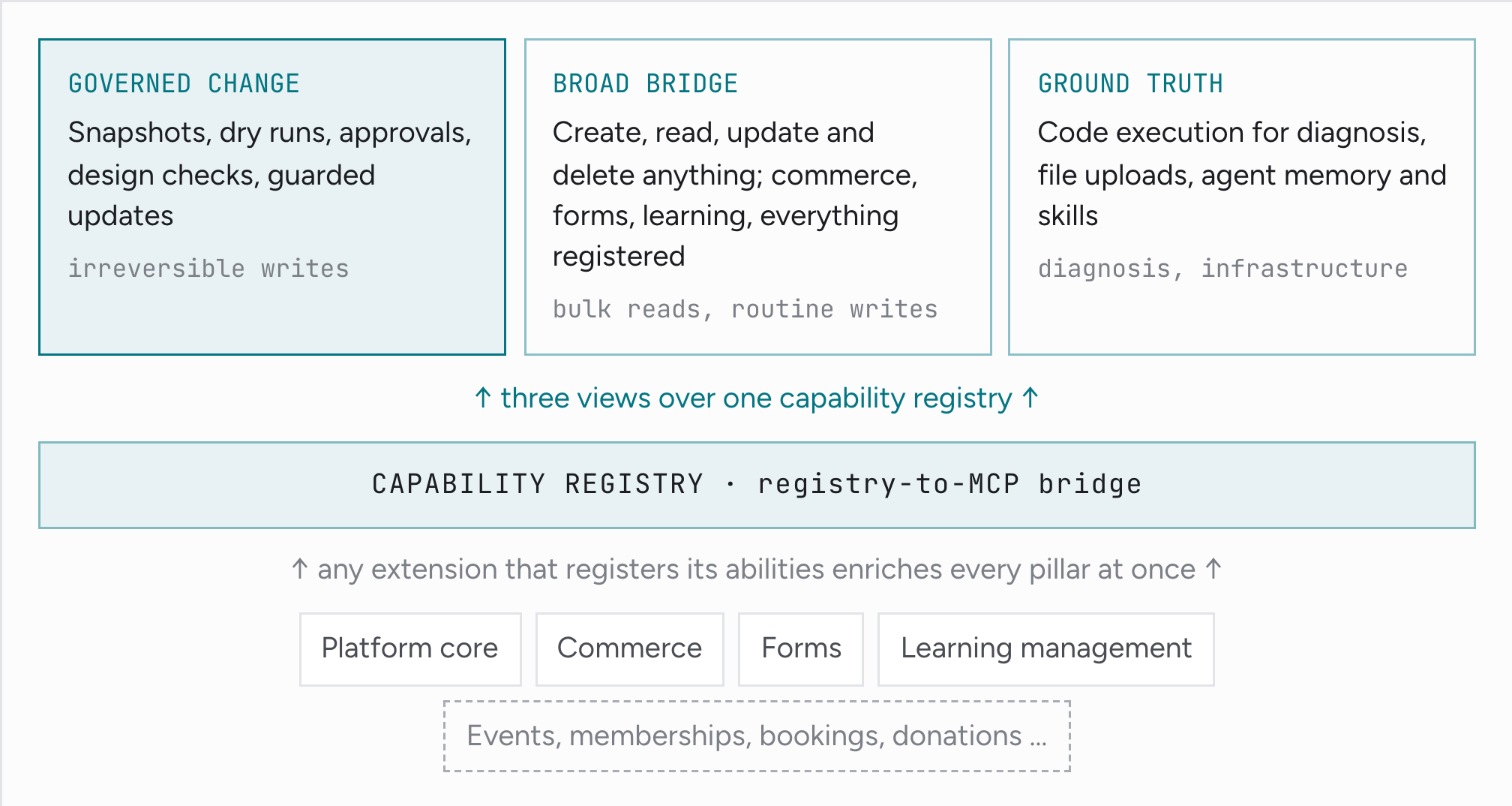
The routing doctrine follows. Bulk reads and whole-content editing go through the bridge, where breadth matters. Anything irreversible goes through the governed platform, where reversibility matters. Diagnosis goes to ground truth. The stack can do more than it can be trusted to police, and the routing table is what closes the gap.
Capability accrues to the architecture
Because all three pillars read the same registry, any extension that declares its abilities enriches every pillar at once, with no integration work by anyone. Commerce, forms and course management have each appeared this way, without anyone writing integration code.
Install a well-behaved extension for a vertical, and the agent inherits the vertical. The architecture is the constant and the registry is the variable. Measured October 5, 2026, the governed web surface held 1,184 agent-reachable tools.
Design is checked, not hoped for
An agent that can edit a page can also make it ugly, off-brand or unreadable, and will do so confidently. The governed platform checks every page write against a named design direction twice: once by rule and once on the rendered page. It catches off-palette color, poor contrast, broken type scale and the generic look an unguided model defaults to. Signed preview links let a person see a change before it goes live.
Knowledge that travels with the site
The agent’s skills, memory and playbooks live on the site itself. Any session that connects receives the current operating doctrine automatically, instead of relying on a runbook that goes stale on someone’s laptop.
The risks, stated plainly
- Concentration. Snapshots and rollback come from one pillar, so the safety of the surface depends on it.
- Specification volatility. The protocol can still change in ways that break compatibility.
- Drift between assessments. Mitigated by a snapshot-before-update rule and scheduled re-assessment.
Give the agent the whole website, but route every write by its risk. Three servers over one capability registry turn trust into a routing decision, and capability accrues to the architecture rather than to a vendor’s roadmap.
Read the full section: Agentic web development
Cite as: revWorx (2026). A Composable Reference Architecture for Autonomous GTM Operations, First Edition, §14. revworx.ai.