
Email will outlive every email platform. That sounds obvious, yet most channel plans are written as tool plans. The result is a common pair of mistakes: reading “we replaced a tool” as “we lost a channel”, or buying a tool to get a channel the stack already had.
The architecture separates the two. A channel surface is a route to a person: the place where your market first sees you, hears from you or talks back. A tool is just whatever happens to provide that route this year.
13 surfaces, three jobs
The architecture provides 13 channel surfaces, grouped by the job each does in a buyer’s journey:
- Found: where your market discovers you, such as AI search, social, organic search and paid search.
- Reach out: where you go to them, such as email, SMS, direct dial, direct mail and personalized video.
- Serve: where you help someone who has already arrived, such as the AI concierge, the partner portal and surveys.
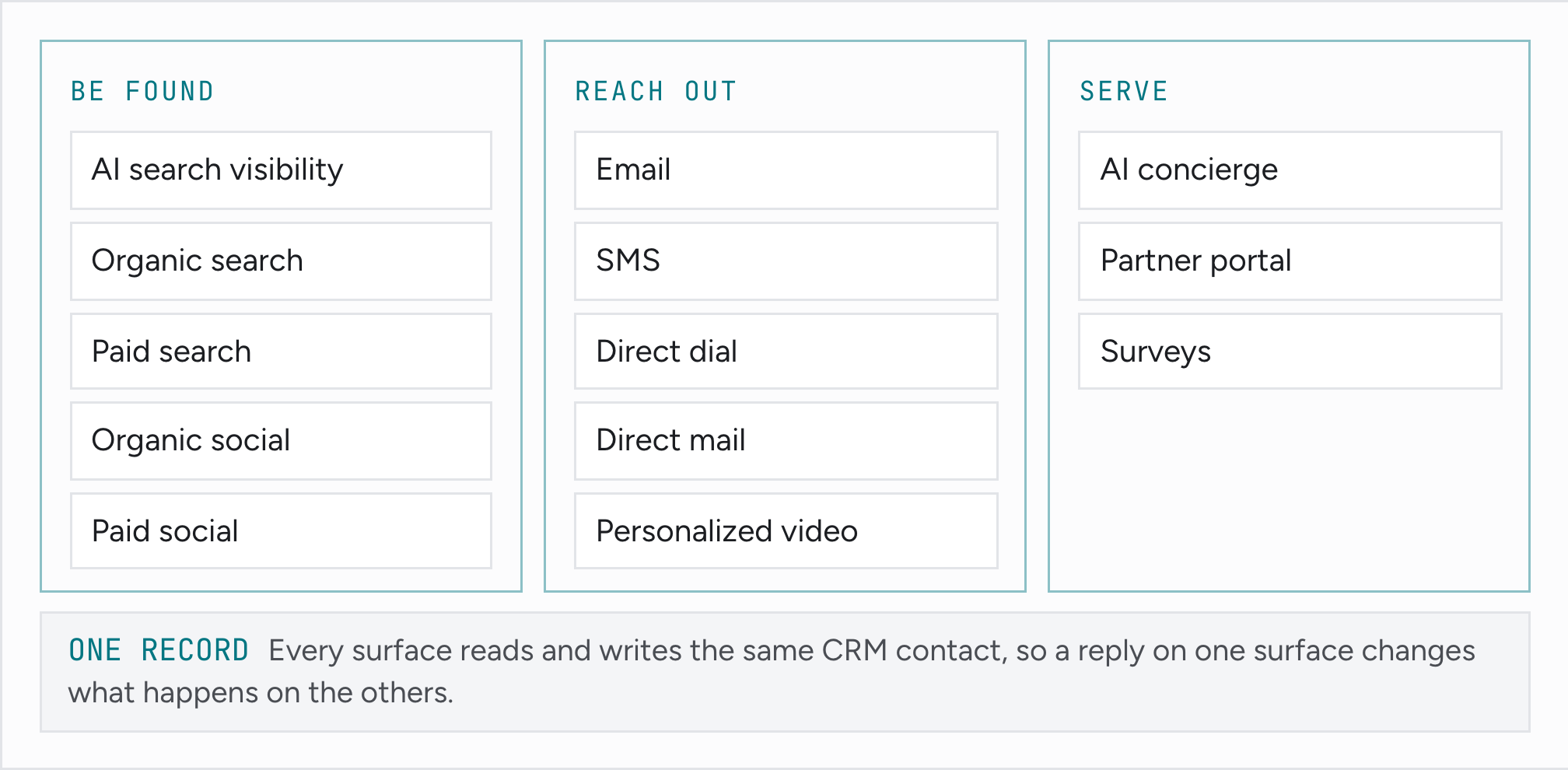
The groups are not funnel stages. A customer served by the concierge may be reached by email later and found through search after that. The grouping exists so one question can be asked of any surface: found, reach out or serve? The answer sets who approves an action, and how it is measured and paced.
What do most channel plans miss?
For each surface the architecture records what provides it, what drives it and the gate that governs it. Spend confirmation inside the tool for paid channels. A suppression check and copy approval for email. Guardrails and escalation to a human for the concierge. That last column is the one most often missing from a channel plan.
Reach out from the system of record
Many of the outbound surfaces come from the CRM itself: email, SMS, direct dial, the partner portal and surveys. That is deliberate. When you reach out from the system that holds the record, every send, reply and bounce lands on the right contact without a sync step, and the suppression list is checked against the same record the message is addressed to.
Three rules across surfaces
- Sequence across surfaces, not within them. A tool-centric stack optimizes each channel alone. An agent that sees every surface sequences them: a prospect who read the guide, opened two emails and visited pricing gets a call, not a third email.
- One suppression list, checked everywhere. Someone who asked not to be contacted stays uncontacted on every surface, including the ones you add next year. That only works when the check lives in one guardrail layer, not in each tool.
- Measure the surface, attribute to the record. Each surface reports its own engagement, but attribution happens on the contact, where every surface’s events meet. Thirteen dashboards are thirteen opinions about what worked.
Thirteen surfaces, one record
A surface is defined by its job and the record it writes to. Swap the provider behind it and nothing above it changes.
Channels outlive tools. Define each surface by its job and the record it writes to, sequence across surfaces from one place and check one suppression list everywhere.
Read the full section: Channel surfaces
Cite as: revWorx (2026). A Composable Reference Architecture for Autonomous GTM Operations, First Edition, §13. revworx.ai.