
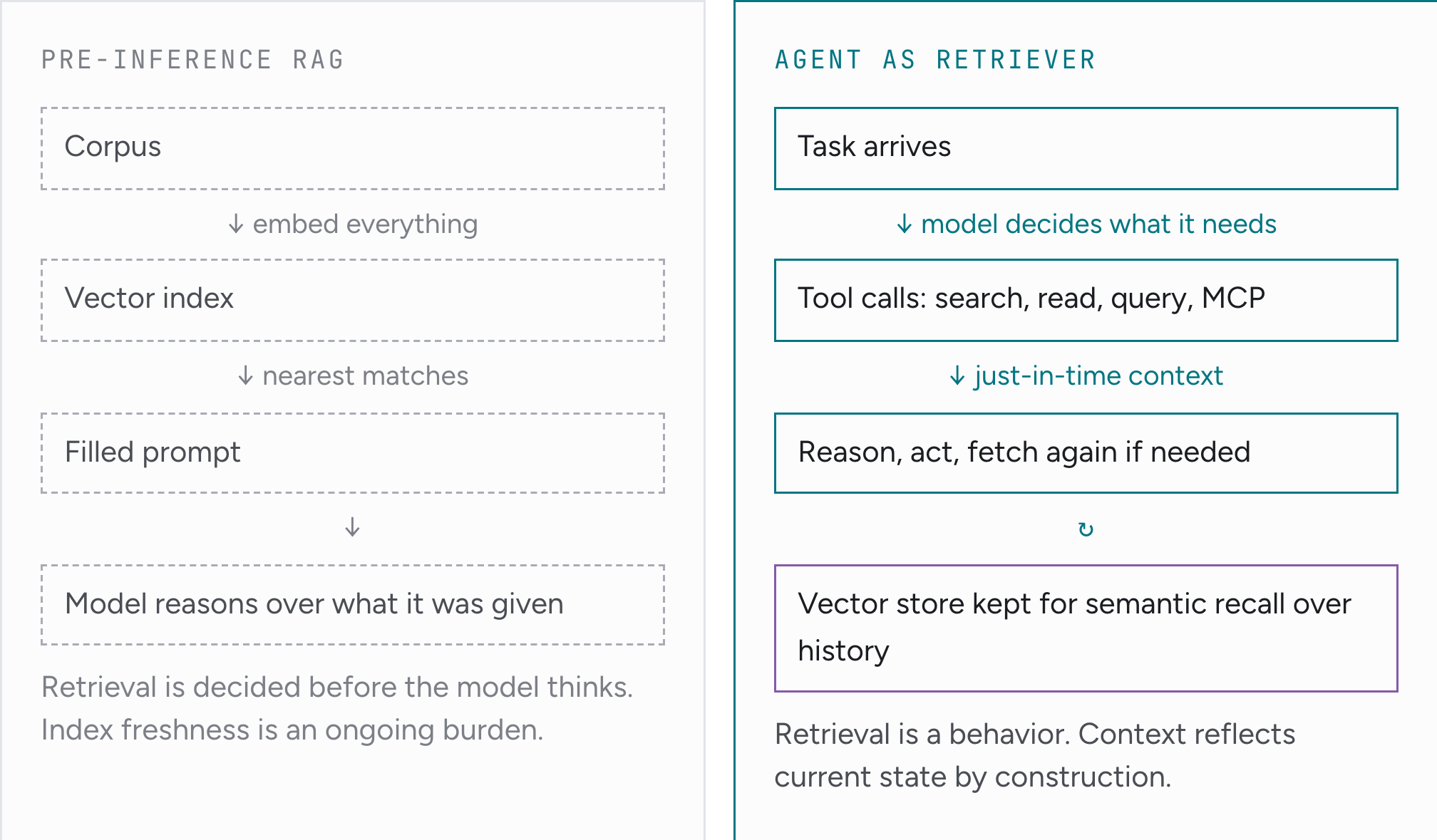
For a while, the standard answer to giving an AI agent knowledge was to embed everything. Convert the whole document collection into searchable numeric fingerprints, pull the closest matches for each question into the prompt, then let the model reason. Retrieval happened to the model, before it thought.
That pattern is being displaced. If your team invested in a retrieval system, the change is worth understanding.
The agent becomes the retriever
In the newer pattern, retrieval is something the model does, through tool calls. The agent searches files, reads records, runs structured queries and calls MCP servers. It loads context just in time, because it has decided it needs it. Nothing is pre-indexed on the chance it might be relevant.
Design principle
Load nothing until it is needed.
Applied to tools, it keeps the standing cost flat. Applied to knowledge, it is just-in-time context.
The real difference is accuracy
An embedded index has to be kept fresh, and a stale one fails quietly. The agent acts confidently on last month’s picture of an account, and nothing tells you it did.
An agent that fetches on demand reads current state by construction. It also spends tokens on what the task needs, not on passages that merely scored well against the question.
Who decides what to retrieve
Set the two patterns side by side and one difference matters most: where the decision about what to retrieve is made.
- Pre-inference retrieval: decided in advance, by whoever built the pipeline.
- Agent as retriever: decided by the agent, at the moment it is working on your account.
Vector search is not retired
Embeddings still do some jobs best. Recalling what was said in a call last quarter, or which conversations touched a given objection, is exactly what they are good at. The architecture keeps a vector store for that purpose.
What changes is the default. Embeddings become one retrieval tool among several, not the only route by which context arrives.
The trade, stated plainly
Tool calls cost latency, and the architecture accepts that trade deliberately. Each call returns current, scoped data, and the smaller prompt usually more than recovers the time. The toolkit is the one a capable engineer already uses: pattern search, direct reads, structured queries and MCP servers for systems of record.
Stop treating retrieval as a preprocessing step. An agent that fetches through tool calls reads current state by construction, and embeddings become one retrieval tool among several.
Read the full section: The retrieval shift
Cite as: revWorx (2026). A Composable Reference Architecture for Autonomous GTM Operations, First Edition, §6. revworx.ai.